

Unlock your Creativity
with Laura Livingston Rubin

Dear Friends,
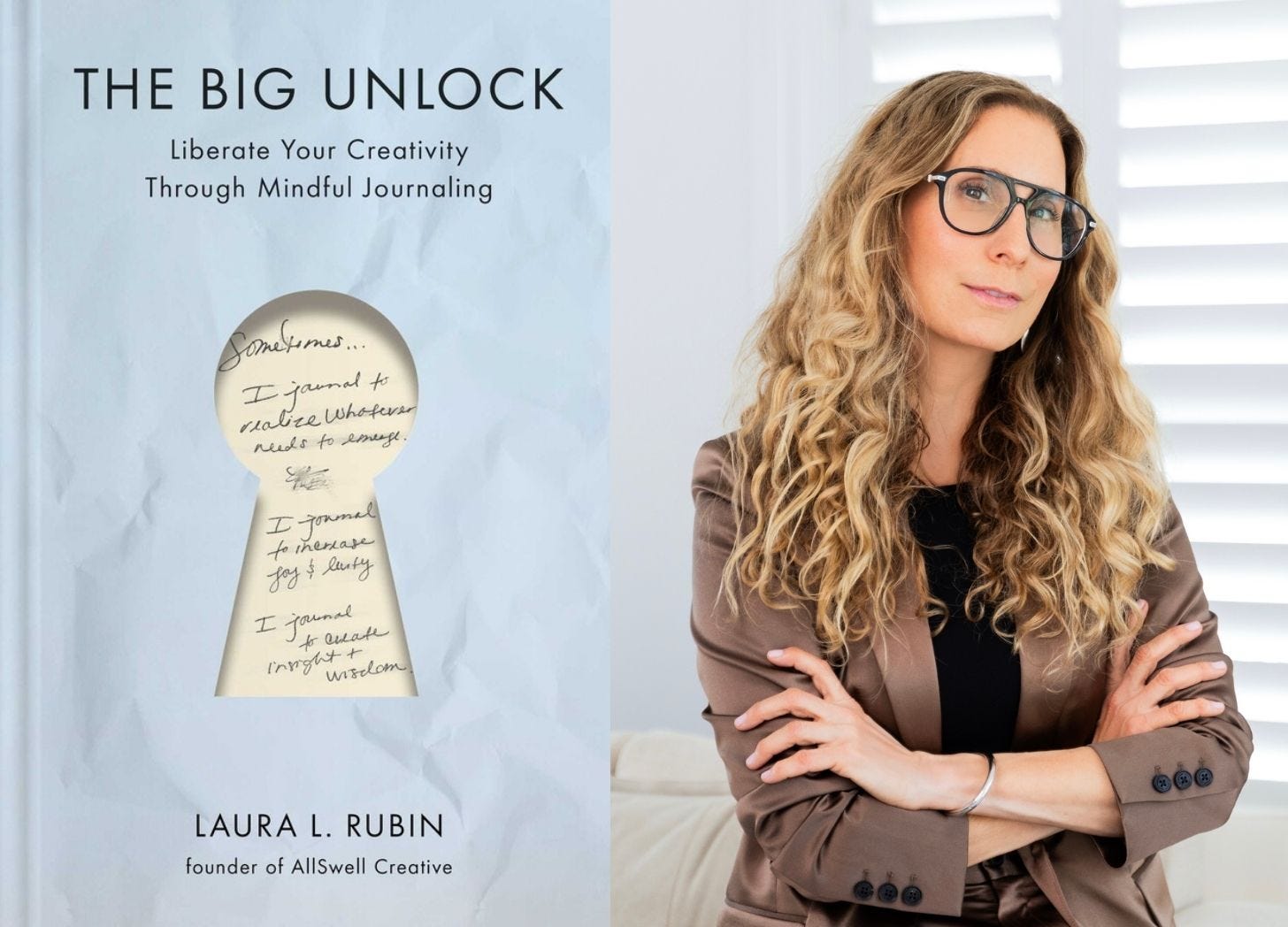
You remember my friend Laura Rubin. We chatted with her about journaling, entrepreneurship, and intuitive risk-taking back in 2024. Well guess what? Laura has written a book on one of our favorite subjects: CREATIVITY. I called her up to get the scoop. We dive into this below, so spoiler alert, but her book is called The Big Unlock, and it’s being published by Simon & Schuster. I am beyond excited to read this book.
If you’d like to join Laura and me for a face-to-face conversation, The Big Unlock tour is coming to Miami. I’ll be speaking with her at Books & Books on Tuesday, April 7, 2026 at 7:00 pm in Coral Gables to talk about The Big Unlock and creative writing.
Joyce Englander Levy
How far back can we start?
Laura Livingston Rubin
The first line of my book is, “I was early, but I wasn’t wrong.”
Joyce
Thank you for that sneak peek!
Laura
I started working professionally in the mindful journaling space as a passion project because my creative process led me here. I call it, following the breadcrumbs. I allow myself to be curious and to follow through. That was essentially how I ended up in the space, despite the fact that I arguably had a thriving marketing-communications business. But I felt like journaling had a really bad PR problem at the time. I knew this modality could help a lot of people, and I was interested in changing the dialogue around what it meant to keep a journal. So, I started AllSwell. It began with design forward, gender-neutral products.

The notebooks led to a much larger conversation with the marketplace. I learned that people had all these hangups around journaling. That was where the idea for a curriculum came from. Adding in my experiential marketing background to create a supportive space—one that was really beautiful and joyful. That was the genesis of the workshops.
Eventually, this little journaling side-project “garden” that I was barely watering or weeding was growing, and I got so curious about what it could do if I actually started tending it. So I wound down my agency and I leaned into this—which looked a little nuts on paper. But in my career, I have followed my intuition, what I’m curious about.
Joyce
How did that lead to your book deal with Simon & Schuster?
Laura
Along the way multiple people have said, “When’s the book coming out, Rubin?” I was flattered, but I wasn’t really ready. I know you’ll understand this when I say, right now in the wellness world, there’s a lot of self-appointed guruism
Joyce
Yep.
Laura
And that was not—at—all the energy I wanted to bring to my book. To me, books are sacred territory. You understand that.
Joyce
Of course.
Laura
And my approach has been to make sure everything related to this work is grounded in peer-reviewed science, and to thoroughly test my approach. So before I felt ready to embark on a book, I wanted to make sure I had a body of work I could refer to—one that was more than just nice ideas and good intentions.
I’ve accumulated over a decade’s worth of workshops, coaching retreats, facilitating experiences, leading people to the page. I utilized all of that experience in The Big Unlock. By the time I wrote it, I’d already made a ton of mistakes and those got weeded out; I’ve also learned what works and how to host in different environments, and demographics. That’s the content I focused on, the tried-and-true best practices.
Joyce
So, how did you actually get the book deal? Did you get an agent? Did you send out a proposal and find a publisher? Did the publisher find you after your New York Times article?
Laura
OK, so I was living in California and had a general idea of—I think it’s time to write a book, and I have a friend who has written many books. Her name is Jessica Hundley. I was completely overwhelmed and intimidated at the process of a book proposal, I didn’t understand what it was. I didn’t know how to do it. I didn’t understand how it worked. And she’s authored, ghost written, and co-written a number of books. She’s a pro. I reached out to her for her advice, and she said “You probably already have most of your book written, Laura. You don’t even realize it.” She said, “You already publish so much original IP, and you have so many workshops, this is probably going to be a lot easier than you think.” That’s actually laughable now, but nonetheless it really helped me to believe it at the time!
I also needed accountability because, as an entrepreneur, writing a book proposal fell to the bottom of my to-do list over and over again. Jessica created deliverable timelines, and hosted me for co-writing sessions. She would invite me over to her writing yurt in Echo Park, and we would talk through where I was. We would investigate different potential organizing principles for my book, ways to structure it. And I would sit down and get work done right there and then. All of that was enormously helpful.
So I had the bones of a proposal in the works, more than bones at that point, I had a taxonomy. I had a concept and a rough table of contents.
Then I ended up moving back to the East Coast. When I came back I said, “I’m gonna go to anything anybody invites me to.” I was trying to reintegrate into a community here, because I’d been gone for a decade.
You
I love how sometimes we creative-workaholics need to remind ourselves to socialize.
Laura
Totally. I was invited to a Fourth of July fireworks barbecue by a friend. It was going to take an hour in bad traffic to get there. I decided to go anyway, despite the fact that that sounded like a risky proposition. It turns out that a New York Times writer sat next to me and asked me what I did. I shared a bit with her. She kept asking me more questions. I thought she was just being polite and I actually even said, “You’re being so thoughtful. I don’t want you to feel like you have to keep asking me about my work.”
You
Yes?
Laura
But she kept coming back to it over the course of the evening. Later, I was sitting at a table with my friend, and the writer said, “Laura, I think it’s time for a New York Times feature story in the style section.”
You
Oh my God, chills.
Laura
Yeah. I didn’t immediately respond because I was so stunned. I looked at the writer, and I looked at my friend, and she looked at me, and I looked back at the writer. The writer said, “Unless you don’t want it, which I completely understand. It’s not for everybody, and I completely respect it if you don’t wanna do that. I get it.”
I was like, “No no no, that would be great.”
You
Amazing, how fun.
Laura
Yeah, but I was such an idiot. I didn’t even get her information and I couldn’t follow up with her.
You
But she knew where to find you.
Laura
Yes, thankfully, she followed up with me.
You
Not surprised.
Laura
And she said, “The story has a green light, but I need to come to a workshop. Do you have any going on?”
I actually didn’t because I was so new to town, but that wasn’t going to stop me. I said, “Yes. Yes, I do. What dates are good for you?” And I quickly called one of my friends, Eddie Berrang, who was a publisher of a magazine out in Montauk. He had a pop-up space, and I asked, “How would you like for me to lead an AllSwell journaling workshop at your space and have it be covered by the New York Times?”
He was like, “Hot damn, let’s do it.” I kind of just MacGyvered the thing.
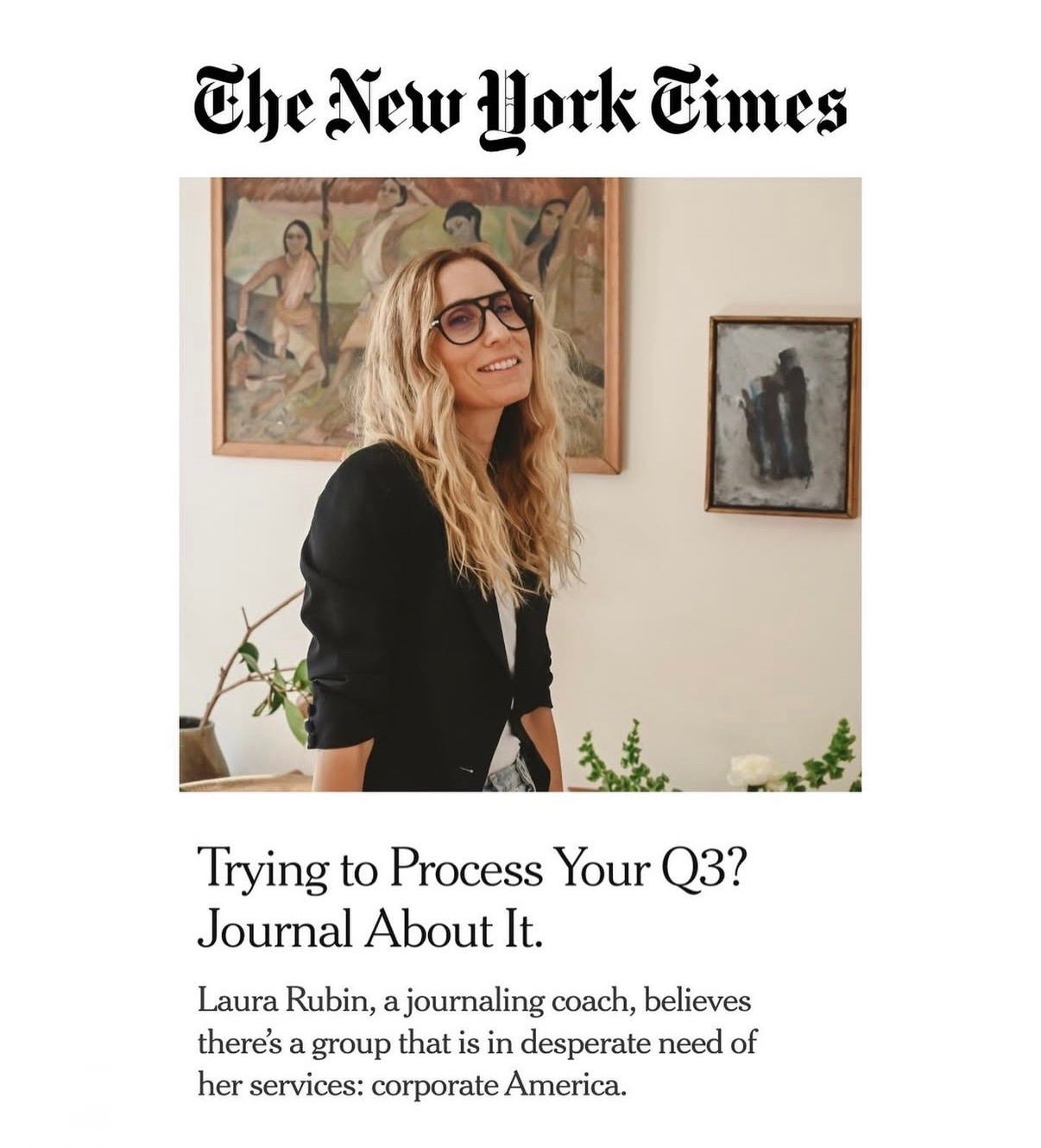
It was grassroots, a quick turnaround. I did the flowers, did my own catering, and we both invited people. And that was the basis for the story which ran in print and online. One of the things that was great about it was that it didn’t just run in the Style section. It also ran in the Business section online.
You
Oh, I didn’t realize.
Laura
Yeah, and that was what really amplified my practice.
You
Cool. I like that you call it a practice. I think of a practice as meaning you are committed in a daily way, you do your best in every occurrence and iteration, and you always act with the acknowledgement that you can learn and improve.
Laura
That’s part of what I love about being a facilitator; I’m never done learning; I’m never done improving. I get to ask questions and read and think and learn and listen, and then bring back some of those pearls to my community.
You
OK, so then, how did the New York Times article lead to the book deal?
Laura
That article led to a call from Prada. I did a workshop for Miu Miu VIPs in New York City. It also led to a call from Google, and I led a workshop for some of their data analysts at their campus in California. Two wildly different psychographics in a short period of time was such a thrill. I was talking about it with my friend Adam Rosante, and he said, “You should talk to my literary agent. She’s great, you’ll love her. I really trust her.” I really trust Adam so I said, “Sure!” I talked to one literary agent, Joy Tutela. She signed me. That was that.
You
Um, I love the word psychographics, and I love Adam Rosante, and I love that you put in so much work on the front-end that when it came to finding an agent you were quickly in such great hands.
Laura
And it happens to be the agency that reps Maggie Smith and Julia Cameron, who wrote The Artists Way, two major figures in this work. I felt like the David Black agency would be a really good place for what I do.
You
Yes, I’ll say. Cool. So then…
Laura
Creating the proper book proposal was such a painful process. It took months. But eventually we took it out to market. It was pretty surreal. We talked to a whole bunch of different publishers and eventually Simon & Schuster emerged as the best home for the book.
You
Amazing. And you have an editor that you work with at Simon & Schuster?
Laura
Yes, Ronnie Alvarado. I love her. I would trust her with my life. I would trust her with my dog’s life. She’s been a tireless advocate. She’s been so patient and helpful and kind. She’s made it a better book, for sure.
You
So tell us more about your writing process
Laura
This is the most important lesson I can share from the whole book process.
I had over a decade’s worth of experience, honing my voice in this space. I had a confident voice on the page writing newsletters, blog posts, social content, workshops and more. I had a defined voice. I had a proposal’s-worth of my voice. I had four sample chapter’s-worth of my voice. Then I started to write a “capital B” BOOK. And I froze.
In my head, the imposter syndrome was so intense that I ended up writing the first whole section of my book like I was trying to sound like Arthur C. Brooks.
You
How did that happen?
Laura
Because I was so bound up in what I thought people would take seriously. I sounded like somebody completely different than what the publisher had bought. I had to write my way back to my own voice.
You
I suppose your own journaling work was there to meet you and get you through it. In what section will we be able to find The Big Unlock in bookstores?
Laura
It’s a book on creativity.
You
Cool, so next to The Artists Way?
Laura
Yeah, I hope so. And Rick Rubin’s book, and Big Magic, and Writing Down the Bones. Books like that.
Joyce
Okay, before we have to go, talk to me about EndsWell.
Laura
It’s one thing to write a book, but it’s quite another to promote one. Despite my very real and pressing sense of mission about getting people to the page, I was highly uncomfortable about all the self-promotion that it became clear would be necessary. So I journaled about it. And I came up with my own “unlock.”
Instead of the book promo process being just about me, me, me ( “Please, buy my book”), I created a new non-profit arm of AllSwell, the EndSwell Collective.
Joyce
What does EndsWell do?
Laura
EndsWell matches facilitators I’ve trained with charities that serve groups of people in need.
I’ve been training people to do this work for a couple of years via AllSwell’s “Superconductor” program. Now I can tap these cohorts – a trained, international network of vetted journaling workshop facilitators – and pair them with communities that will benefit tremendously from these activities. This is not a volunteer opportunity. I am fundraising on the book tour. Endswell will pay a dignified wage to those who are involved in our program as facilitators, enabling them to financially benefit from doing altruistic, meaningful, creative work.
Some of the initial programs in early development will support people going through cancer treatment, demoralized climate change activists, caregivers for loved ones dealing with degenerative illnesses, and more. These groups will benefit from a no-cost analog modality that supports their mental and physiological well-being.
And it amplifies the effect of my work well beyond what benefits me and my business. I needed that shift in order to be able to comfortably switch into promo mode. It has to be about more than me. That was my big unlock.
Joyce
Laura, it’s an honor to be your friend. Thank you for sharing your story with all of us at Look Both Ways. I’ve pre-ordered The Big Unlock, and I can’t wait for it to arrive on March 31st. You’ve already helped me unlock so much creativity and love in my life, and now I feel it’s just the beginning.
Wow, fabulous and exciting for both of you...xoxo
Such a wonderful post, and wonderful story-----I look forward to seeing you both in conversation @ Books & Books and I want to check out the various programs you have created ---sounds really AMAZING...mazel tov!!!!